
Andhra Pradesh, June 9 : A new policy paper released in the Open Archive of social science (SocArXiv) tells the stories of multiple communities across Odisha and Andhra Pradesh who are doing something quietly remarkable: managing land, water, and forests as a single, interconnected system, and seeing their landscapes and their lives transform as a result.
The Centrality of Area-Based Approaches in Sustainable Development, released in May 2026, draws on these ground-level experiences alongside expert deliberations held by Common Ground Initiative at the Commons Convening 2024 in New Delhi and the India Land and Development Conference (ILDC) 2025 in Ahmedabad. This paper makes the case that what these communities have demonstrated, an area-based approach, can be successfully replicated. Building on these cases and expert deliberations, the paper offers a powerful model for how India might approach the management and governance of its most stressed natural resources.
A Crisis That Cannot Wait
India is home to 16% of the world's population but accounts for just 2.4% of its total land area, placing its natural resources under considerable and growing stress. By 2018–19, nearly 98 million hectares, roughly 30% of India's total land area, was already degrading. The country has lost an estimated 90% of the area under its four biodiversity hotspots. And nearly half of all agricultural land in India is farmed by small and marginal farmers who are most vulnerable to the climate change.
The communities of Keonjhar and Koraput in Odisha and those across Andhra Pradesh continue to live within these realities. The paper documents the area-based approaches through which these communities are responding to these challenges, while identifying lessons from these communities’ responses.
What These Communities Are Doing Differently
Central to the shift that makes these communities resilient is that they moved from fragmented, scheme-by-scheme interventions to treating the entire landscape, its soil, water, forests, crops, and people, as one connected system.
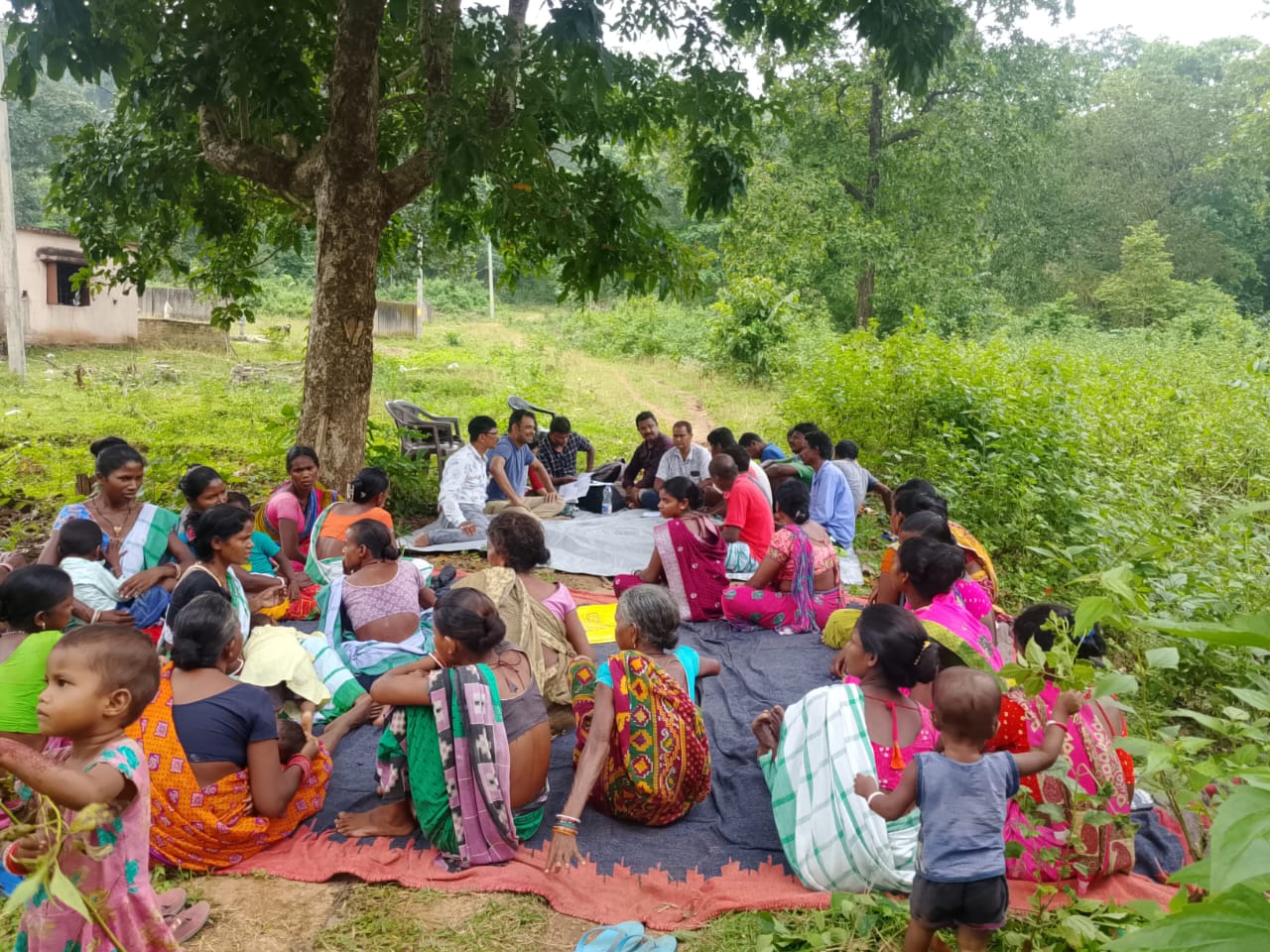
In Keonjhar, the Women's Organisation for Socio-Cultural Awareness (WOSCA), a non-governmental organisation, brought together local government bodies, civil society groups, and communities around a shared landscape plan. Digital mapping tools were placed in the hands of communities alongside their own traditional knowledge of the land. The result was increased water tables, improved soil moisture and better harvests. Villages were no longer losing their crop produce to drought.
Mansingh Durga Prasad Naik from WOSCA says, “women self-help group members in Keonjhar are becoming like stewards; they are working like change agents.” Reflecting on their work with these groups, he says "When community will be empowered with data, with intention and when they will be clubbed with all Civil Society Organisations and Community-based Organisations then something is going to change, the whole ecosystem.”
In Koraput, another non-governmental organisation, Watershed Support Services and Activities Network (WASSAN) worked on creating a multi-actor platform around a landscape: a structured space where farmers, women's groups, government departments, and civil society organisations meet regularly, share data, and plan together. Crucially, they also stitched together a blended finance model, drawing on public schemes, philanthropic capital, and community-level credit because no single funding line can accommodate landscape restoration comprehensively.
In Andhra Pradesh, the community-managed natural farming programme has taken these principles to a much larger scale, of over a million farmers and nearly half a million hectares, making it the largest natural farming programme in the world. Like in Koraput and Keonjhar, this programme also brings together multiple actors. It builds on a network of women's self-help groups facilitating peer-to-peer learning among farmers, and local accountability.
Emphasising that an area-based approach cannot rely on blueprints or predefined plans, but requires a progressive and adaptive strategy, G. Murlidhar from Rythu Sadhikara Samstha (RySS), Andhra Pradesh says, “Don’t wait for a complete plan, the complete plan never happens. When will there be a complete, comprehensive plan? Start with anything quickly.”
From Ground Reality to Policy
The paper identifies five interconnected shifts needed for area-based approaches to move from such promising examples to a mainstream practice: a systems perspective in planning, smarter use of data and digital tools, bottom-up community-led design, financial architecture aligned with long ecological timescales utilising schemes such as the direct benefit transfer (DBT), and greater coherence between policy intent and ground-level implementation.
Dr. Veena Srinivasan from Water, Environment, Land and Livelihoods (WELL) Labs highlights that the shift to an area-based approach requires a fundamental shift in the thinking away from the current model, where specific grassroot organisations act as the owners of specific landscapes. She says that in an area-based thinking “the locus of power or decision making should sit with the community-based organisation whether self-help group, or, it could be, if we work in command areas, water user cooperatives or farmer producer organisations whatever it is, but collectives of people that live in the landscape who intend to own the landscape and not leave the landscape no matter what happens.”
Way Forward
The paper calls for area-based approaches to be recognised as central to India's natural resource planning, as an organising principle that draws existing programmes, communities, and investments into greater alignment around the social-ecological realities of specific places.
It also identifies practical entry points for this shift: digital planning tools such as Know Your Landscape and Gramify that can support participatory, landscape-level planning; blended finance models that can sustain long-term landscape investments; and field schools at the village level that can demonstrate and spread what is already working.
This paper shows that the knowledge, the tools, and the community institutions needed for landscape restoration already exist in India, and the opportunity now is to learn from them and build on them.