
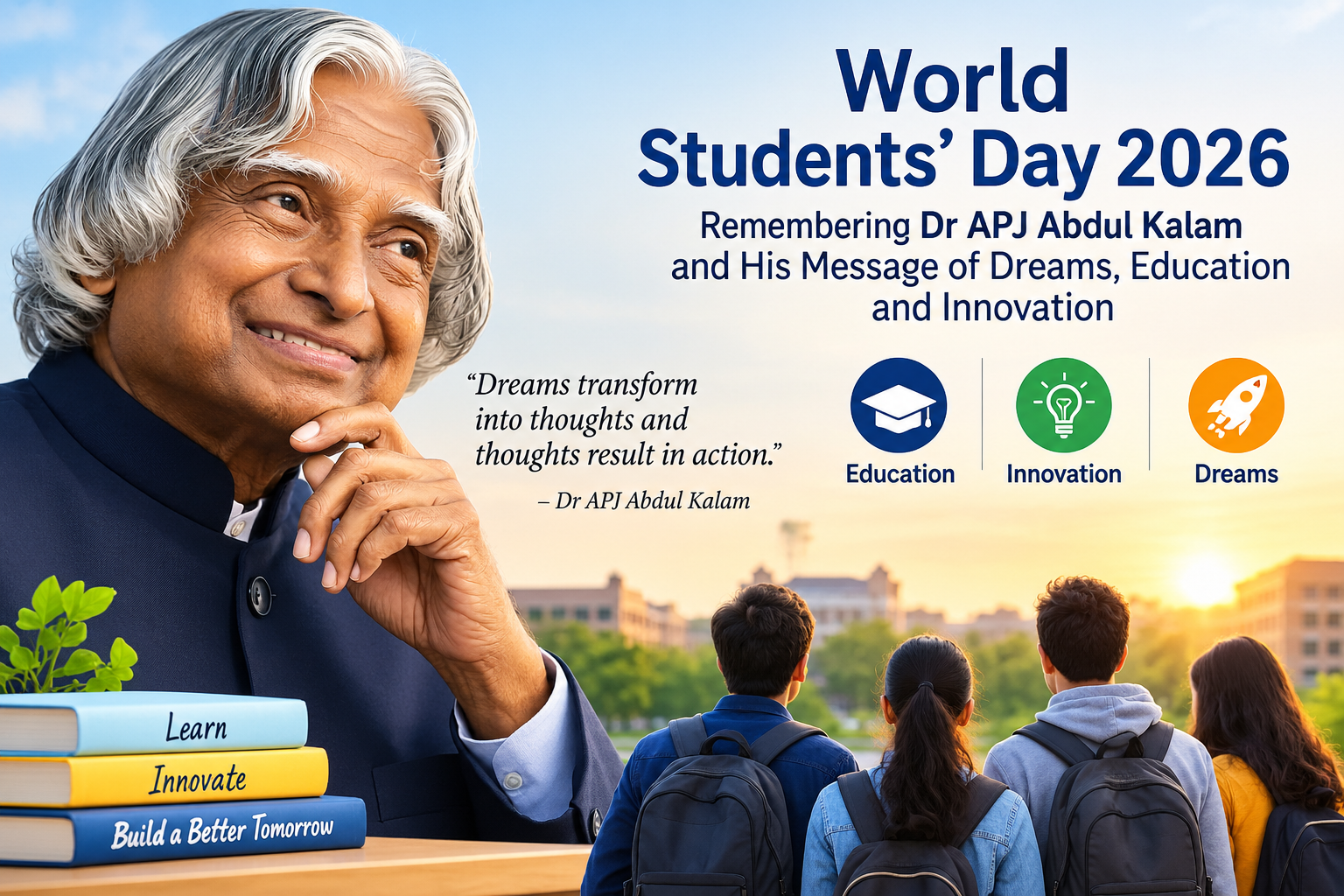
Oct 15: Every great achievement begins with an idea, a question or a dream. Dr APJ Abdul Kalam believed that young people had the ability to turn such dreams into reality through education, hard work and a willingness to keep learning. His life, from his childhood in Rameswaram to becoming India’s 11th President, continues to inspire students to look beyond limitations and work towards a better future.
Observed on October 15 in India in honour of Dr Kalam’s birth anniversary, World Students’ Day celebrates his lasting connection with students and his belief in the power of knowledge. Born on October 15, 1931, Dr Kalam became a renowned aerospace scientist, contributing to India’s space and missile programmes before serving as President from 2002 to 2007.
As World Students’ Day 2026 is observed, his message of dreams, education and innovation remains relevant to young people navigating changing career opportunities, new technologies and growing expectations.
Dr APJ Abdul Kalam’s Message to Students: Dream Big and Work Towards It
Dr Kalam often encouraged students to have a clear vision for their lives and develop the determination to pursue it. His message was not simply about imagining success. It was about putting in the effort, developing the necessary skills and continuing even when the journey became difficult.
For students, this is an important lesson. Academic setbacks, examination pressure and uncertainty about careers can sometimes make the future seem overwhelming. But a disappointing result does not define a person's abilities or determine what they can achieve later in life. Learning from mistakes, asking for help and trying a different approach can open new possibilities.
A dream might mean becoming a scientist, building a business, improving healthcare, developing new technology or making a difference in one's community. Whatever the ambition, progress begins with curiosity and consistent effort.
Education Is More Than Examination Results
Good marks can open doors, but education should also prepare students to think independently, communicate clearly and solve problems. Dr Kalam’s commitment to young minds reflected the importance of helping students develop their abilities rather than simply memorise information.
That message is particularly relevant today. Artificial intelligence, automation and digital technologies are changing how people study, work and build careers. Students need to understand these tools, but they also need creativity, critical thinking, teamwork and the ability to judge information carefully.
Practical learning can help bridge the gap between classroom lessons and real-world challenges. Science projects, internships, vocational courses, research activities and community initiatives give students opportunities to apply what they know.
Access remains a concern, however. Financial difficulties, limited internet connectivity and a lack of educational resources can restrict opportunities for many learners. Improving access to quality education and practical training is essential to helping more students realise their potential.
From Science to Innovation: A Legacy That Inspires
Dr Kalam's career demonstrated how education and scientific curiosity can contribute to national progress. At the Indian Space Research Organisation (ISRO), he played a key role in the development of India's first indigenous satellite launch vehicle, SLV-III, which successfully placed the Rohini satellite in orbit in 1980. He later contributed to India's missile development programme at the Defence Research and Development Organisation (DRDO).
Yet his legacy extends beyond these scientific achievements. He wanted young people to see knowledge as a tool for finding solutions and creating opportunities.
Today, students can carry that spirit into fields such as artificial intelligence, robotics, healthcare, agriculture, renewable energy and environmental protection. Innovation does not always require a major invention or an expensive laboratory. It can begin with noticing a problem and asking whether there is a better way to solve it.
Schools and colleges can encourage this mindset by providing opportunities for experimentation, collaboration and project-based learning.
Why Teachers Play a Vital Role in Shaping Young Minds
Behind many successful students is a teacher who offered encouragement at the right moment. Dr Kalam recognised the importance of education and devoted considerable time to interacting with students, sharing ideas and encouraging young people to think about the future. His official presidential profile records his commitment to engaging school students and inspiring young minds.
Teachers do more than explain lessons. They help students recognise their strengths, ask meaningful questions and gain confidence in their abilities. They can also guide students in using technology responsibly and distinguishing reliable information from misleading content.
Supporting teachers with training, learning resources and opportunities for professional development is therefore an important part of strengthening education.
How Students Can Put Dr Kalam’s Ideas into Practice
Remembering Dr Kalam can be more meaningful when his message becomes part of everyday life. Students do not need to make dramatic changes overnight. Small, consistent efforts can help them build knowledge and confidence.
Reading beyond the syllabus, learning a new skill, taking part in science projects and exploring subjects outside one's comfort zone are useful starting points. Students can also participate in debates, environmental initiatives, coding activities and community service to understand how their knowledge can help others.
It is equally important to learn from failure. Not every idea will work the first time, and not every goal will be achieved immediately. Seeking feedback, understanding mistakes and trying again can be valuable parts of the learning process.
Educational institutions can support these efforts through innovation challenges, career guidance sessions, discussions with researchers and entrepreneurs, and activities that reward creativity as well as academic achievement.
World Students’ Day 2026: Keeping Dr Kalam’s Message Alive
Dr APJ Abdul Kalam is remembered not only for his achievements as a scientist and President, but also for the confidence he placed in young people. He believed that students could contribute to India's future when given the opportunity to learn, think independently and pursue meaningful goals.
That belief remains important as students prepare for careers shaped by technology, changing industries and new social challenges. They need access to education, guidance from teachers, practical experience and the confidence to explore their ideas.
World Students’ Day offers an opportunity to reflect on how families, schools, colleges and society can help young people turn their aspirations into action. It is also a reminder that a student's potential should not be judged only by examination results or present circumstances.
Remembering Dr Kalam means keeping his spirit of curiosity, learning and innovation alive. Every time a student asks a question, works through a difficult problem or uses knowledge to help someone else, that message finds a new expression.