
In 2026, Augmented Reality (AR) and Virtual Reality (VR) have firmly moved beyond experimental use cases to become powerful tools transforming modern education. What once seemed futuristic is now increasingly integrated into classrooms, training environments, and digital learning platforms worldwide. With the global AR/VR education market witnessing rapid expansion, these immersive technologies are reshaping how knowledge is delivered, experienced, and retained.
A New Era of Immersive Learning
Education has always evolved alongside technology—from chalkboards and textbooks to smart classrooms and digital platforms. AR and VR represent the next leap forward by enabling experiential learning, where students actively engage with concepts rather than passively consuming information.
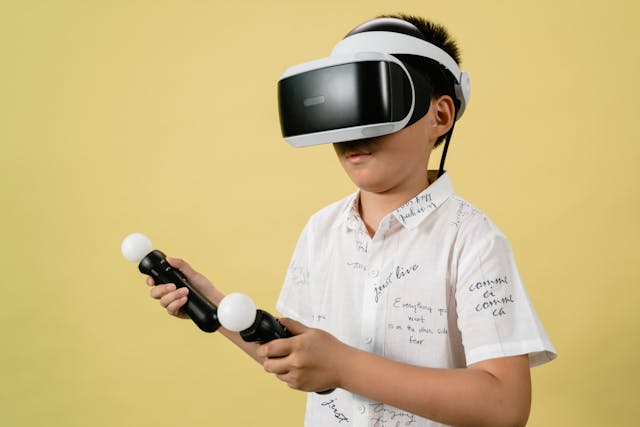
Virtual Reality allows learners to step into entirely different environments—walking through ancient civilizations, exploring outer space, or diving deep into the human body. Augmented Reality, on the other hand, enhances the real world by overlaying digital elements such as 3D models, animations, and interactive visuals onto physical surroundings. This combination transforms traditional lessons into engaging, multi-sensory experiences that improve both comprehension and curiosity.
Transforming Learning Across Educational Levels
AR and VR are making a significant impact across all stages of education.
Early Childhood Education:
For young learners, AR and VR make education more interactive and enjoyable. Storybooks come alive with animated characters, while VR environments allow children to explore forests, oceans, or even space. These immersive experiences stimulate curiosity, creativity, and cognitive development at an early age.
Primary and Secondary Education:
In schools, immersive technologies are revolutionizing subjects like science and history. Virtual laboratories enable students to conduct experiments safely, while AR-based biology tools allow interactive exploration of anatomy. History lessons become engaging journeys through time, where students can virtually visit historical landmarks and events.
Higher Education:
At the university level, AR and VR play a critical role in practical and skill-based learning. Medical students can perform virtual dissections or practice surgeries in a risk-free environment, while engineering students can simulate complex systems and test designs. These tools bridge the gap between theory and real-world application, enhancing both confidence and competence.
Enhancing Engagement and Retention
One of the most significant advantages of AR and VR is their ability to improve student engagement. Traditional teaching methods often struggle to maintain attention, especially for complex or abstract subjects. Immersive technologies address this challenge by making learning interactive and visually compelling.
Studies suggest that immersive learning can significantly improve knowledge retention. When students “learn by doing,” they form stronger cognitive connections compared to passive learning. For instance, exploring a virtual ecosystem or conducting a simulated experiment creates a lasting impression that textbooks alone cannot achieve.
Personalized and Adaptive Learning
AR and VR technologies are increasingly being integrated with Artificial Intelligence (AI) to deliver personalized learning experiences. These systems can analyze student performance in real time and adapt content accordingly.
For example, a VR simulation can adjust its difficulty level based on a student’s progress, while AR applications can provide customized feedback and guidance. This ensures that each learner receives instruction tailored to their pace and style, improving outcomes and reducing learning gaps.
Practical Training Without Risk
In fields that require hands-on expertise, AR and VR provide a safe and cost-effective alternative to real-world training. Students can practice complex procedures repeatedly without the risk of errors or accidents.
Medical students can simulate surgeries, aviation trainees can practice flight operations, and engineering students can experiment with machinery—all within a controlled virtual environment. This not only enhances skill development but also reduces costs associated with physical resources and equipment.
Bridging Accessibility and Global Gaps
Another transformative aspect of AR and VR is their ability to make education more inclusive and accessible. Virtual classrooms enable students from different parts of the world to learn together, breaking geographical barriers.
Additionally, these technologies can be tailored to support diverse learning needs. For instance, AR can provide audio-visual assistance for students with disabilities, while VR can create distraction-free environments for focused learning. This ensures that education becomes more equitable and adaptable to individual requirements.
Market Growth and Technological Advancements
The rapid adoption of AR and VR in education is driven by strong technological and market trends. Increased smartphone penetration, advancements in hardware like AR glasses and VR headsets, and the rise of digital learning platforms are accelerating this transformation.
Moreover, innovations such as spatial computing and immersive “metaverse” classrooms are redefining how students interact with content and each other. These developments are paving the way for more dynamic, collaborative, and interactive learning ecosystems.
Challenges to Overcome
Despite their potential, AR and VR adoption in education faces certain challenges. High initial costs of devices and infrastructure can limit accessibility for some institutions. There is also a need for teacher training to effectively integrate these tools into curricula.
Additionally, the availability of standardized, curriculum-aligned content remains a concern. Technical limitations such as internet connectivity and device compatibility can further impact implementation. However, ongoing advancements and decreasing technology costs are gradually addressing these barriers.
The Future of Learning
The integration of AR, VR, and AI is ushering in a new era of education—one that is immersive, adaptive, and student-centric. Classrooms are no longer confined to physical spaces; they are evolving into interactive environments where learning is driven by exploration and experience.
As these technologies continue to mature, they will play a crucial role in preparing students for a rapidly changing world. By fostering critical thinking, creativity, and practical skills, AR and VR are not just enhancing education—they are redefining it.
Conclusion
AR and VR are transforming education into a more engaging, inclusive, and effective experience. By bridging the gap between theory and practice, these technologies empower students to truly understand and apply what they learn.
In this new educational landscape, learning is no longer limited to books or screens—it is something students can see, feel, and experience. As adoption continues to grow, AR and VR will remain at the forefront of innovation, shaping the future of education for generations to come.
