
Oct 23: For years, high-performing managers have been rewarded for depth. They build expertise, run functions, solve specialised problems, and become known for their ability to deliver within a defined mandate. But the moment they move into broader leadership roles, the rules often change quietly and quickly. The work is no longer only about managing a department, improving a metric, or executing a plan. It becomes about seeing how one decision in finance affects operations, how a technology investment reshapes customer experience, how a people decision influences culture, and how strategy must hold all of this together.
This is where many capable managers discover an uncomfortable truth: functional excellence does not always translate into enterprise leadership. A marketing leader who understands growth may still need to decode margin pressure. A finance leader may need to understand technology adoption. A business head may need to work through AI-led disruption, platform shifts, governance questions, and digital transformation. Senior leadership is not simply a promotion in scale. It is a change in perspective.
That transition has become harder in today’s business environment because organisations are no longer operating in neat functional lanes. Strategy, finance, operations, people, marketing, technology, and risk now move together.Artificial intelligence and digital disruptionhave further tightened these connections. A decision to automate a process is not just a technology decision. It can affect workforce planning, customer trust, productivity, compliance, cost structures, and long-term competitiveness. A leader who views it through only one functional lens may miss the larger consequence.
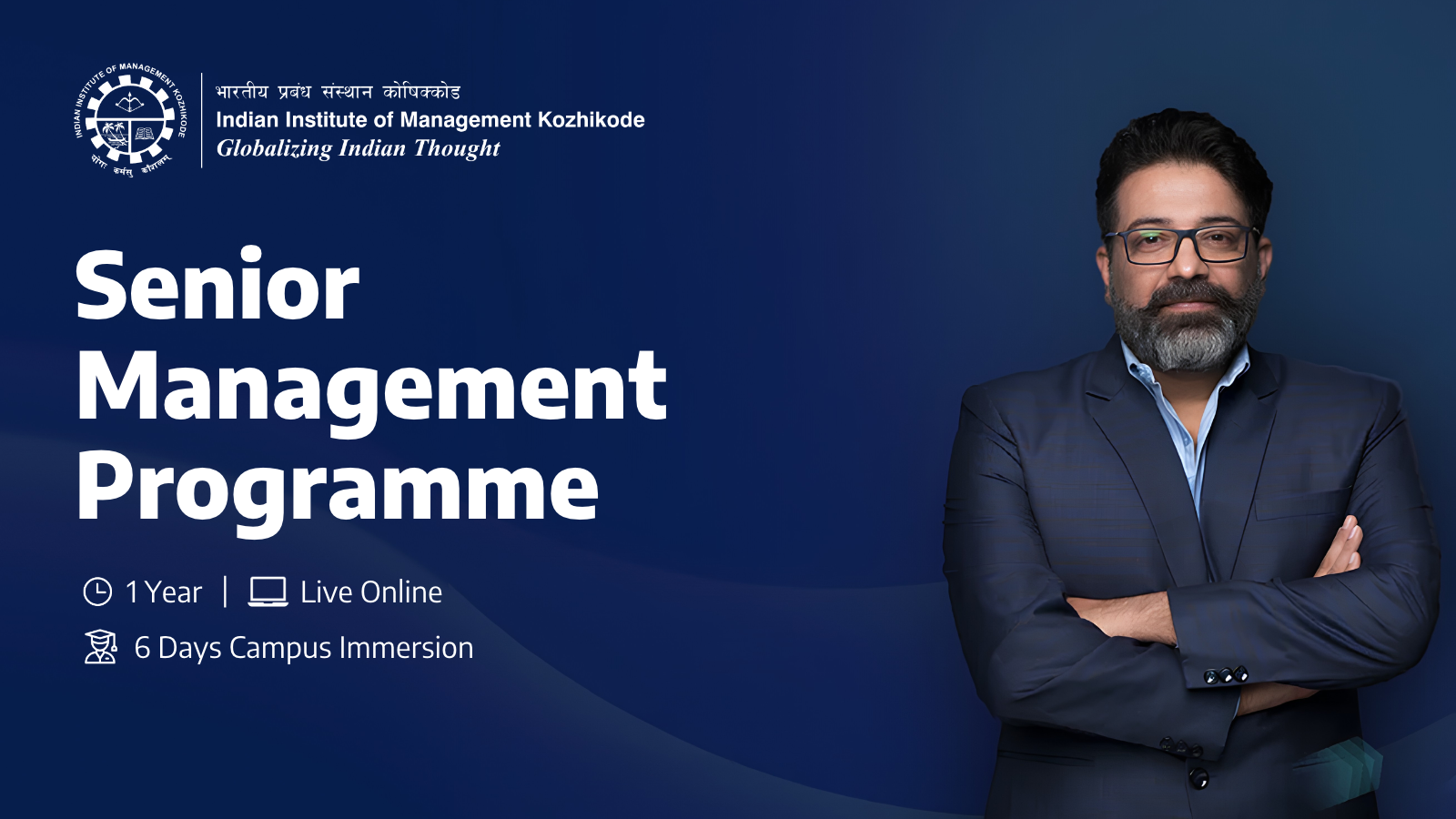
This is why the modern senior management role demands more than experience. It requires strategic judgement, adaptability, and an enterprise-wide mindset. Leaders today are expected to read ambiguity, connect competing priorities, and make decisions that hold up across business functions. It is against this backdrop that theIndian Institute of Management Kozhikode’s Senior Management Programme, now in its 21st batch, becomes particularly relevant. Rather than treating leadership as a set of isolated competencies, the programme is built around the broader realities that senior professionals must navigate. Its cross-functional scope spans strategy, finance, operations, marketing, people leadership, digital transformation, and contemporary technology themes including Generative and Agentic AI. This breadth matters because senior leaders are increasingly evaluated not only on what they know deeply, but on how well they connect what others know deeply.
The value of such learning lies in helping managers shift from a functional command view to an enterprise decision view. Strategy is not meaningful unless it can be financed, operationalised, communicated, adopted, and adapted. Digital transformation is not successful unless people, processes, and business models move with it. AI is not impactful unless leaders can decide where it creates value, where it introduces risk, and where it changes the operating model. In this sense, the leadership challenge is not about knowing every answer. It is about asking better questions across the organisation.
For companies, this shift has direct implications for leadership pipelines. The next generation of senior managers cannot be developed only through tenure or technical performance. They need exposure to broader business thinking before the role demands it from them. Organisations that overlook this shift risk promoting high-performing managers into roles they may not be fully prepared for. Those that invest in executive learning can help build leaders who are more ready for ambiguity, more fluent across functions, and more capable of guiding transformation with judgement.
For professionals, the message is equally clear. The move intosenior managementis not just about doing more. It is about seeing more. It is about understanding the business beyond one’s function, building the confidence to influence across boundaries, and preparing for decisions where there may be no single right answer, only a sharper way to evaluate trade-offs.
As leadership roles continue to expand in scope, continuous executive learning is becoming less of an optional advantage and more of a strategic necessity. For managers preparing to take on wider responsibilities, learning opportunities such asIIM Kozhikode’s Senior Management Programmeoffer a structured way to build that broader lens and explore what it takes to lead beyond the function. For more information about the programme, visit: https://iimkozhikode.emeritus.org/iimk-senior-management-programme